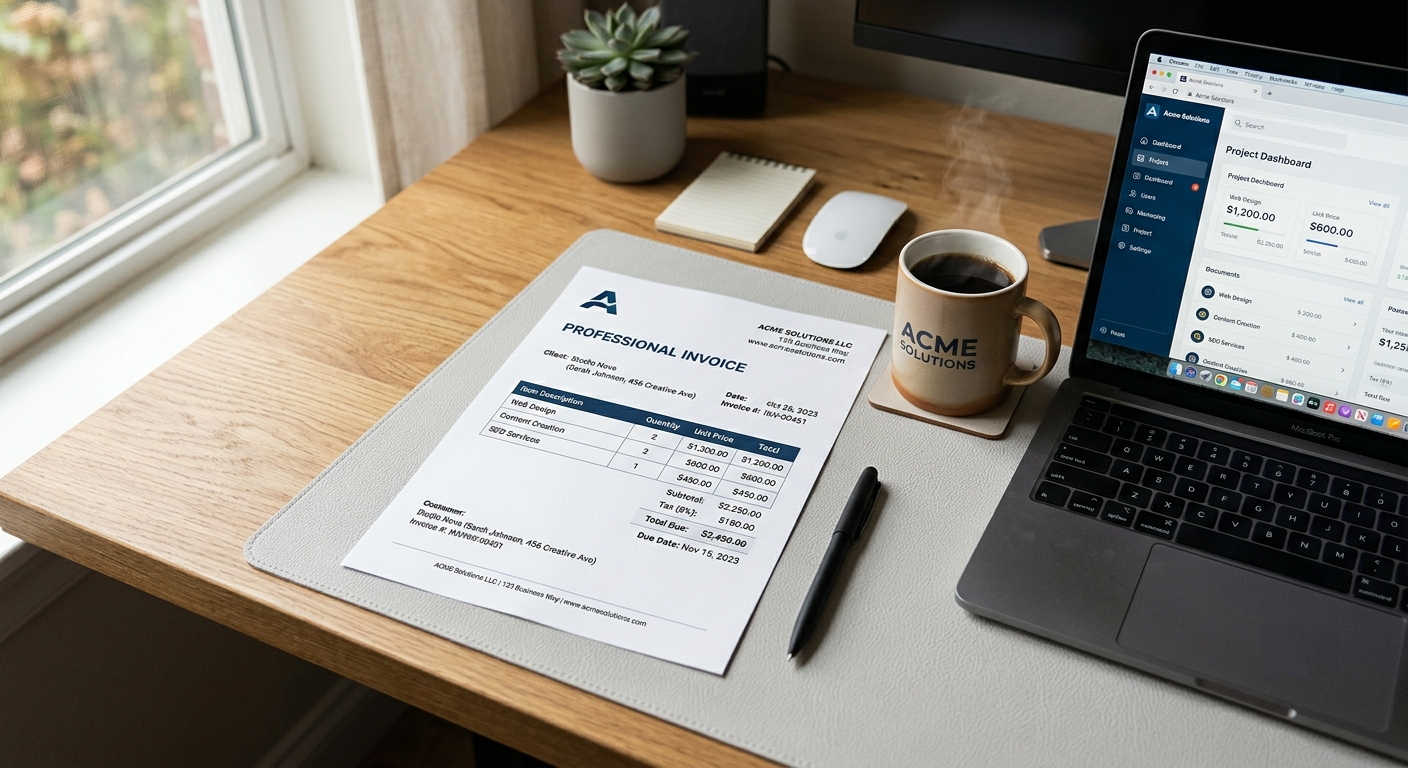
A client pays you $1,850. The bank notification says "Payment from Northwind LLC, ref 7." You have three open invoices with Northwind. None of them are numbered 7. One of them might be. You're not sure.
That's the moment most freelancers realize their invoice numbering system is, well, not really a system.
It sounds like a tiny detail. It isn't. Your invoice number is how you, your client's accounts payable team, and eventually the tax authorities keep track of what was billed, what was paid, and what's still outstanding. Get it right once and you'll never think about it again. Get it wrong and you'll spend a surprising amount of time matching payments to invoices by guesswork.
Here's how to set one up that actually works.
What is an invoice number?
An invoice number is a unique ID you give to every invoice you send. No two invoices should ever share one. It usually sits near the top of the invoice, next to the invoice date, and it's the reference your client uses when they pay you, ask a question, or file the invoice away.
Think of it like a tracking number for money. The invoice number connects four things together:
- The work you did
- The amount you billed
- The payment you received
- Your tax records at year end
Without a number, you're relying on dates, amounts, and memory. Those break down the moment you have two invoices for the same amount, or two clients with similar names.
Is an invoice number legally required?
In the US and Canada, there's no law that tells you exactly how to format an invoice number. The IRS doesn't mandate one, and the CRA's list of required GST/HST invoice details doesn't technically include one either.
But here's the catch. Both agencies expect you to keep records that clearly support the income you report. A clean run of sequential invoice numbers is one of the easiest ways to show that your records are complete. If an auditor sees invoices 101, 102, 104, and 105, the first question is going to be "where's 103?"
On top of that, most mid-size and large companies simply won't process an invoice without a number. Their accounting software needs a unique reference to log it, and duplicate numbers from the same vendor can get flagged or rejected outright.
So technically optional, practically essential.
The five rules of a good invoice numbering system
Whatever format you choose, it should follow these rules:
1. Every number is unique. Never reuse an invoice number, even for a different client, even years later.
2. Numbers go in order. Each new invoice gets a higher number than the last one. This is what "sequential invoice numbering" means, and it's what makes gaps easy to spot.
3. Don't skip numbers. If you void or cancel an invoice, keep it in your records marked as void. Don't delete it and don't give its number to a new invoice.
4. Stay consistent. Pick a format and stick with it. Mixing "INV-12" with "2026-013" and "Acme3" makes your records harder to sort and search.
5. Keep it readable. Your client might need to type it into a payment reference field or read it over the phone. "2026-042" works. "INV/NW/Q3/2026/WEB/042-A" does not.
Five invoice number formats (with examples)
There's no single right format. The best one depends on how many invoices you send and how many clients you have. Here are the five most common approaches.
1. Simple sequential
Example: 0001, 0002, 0003
The most basic system. Start at a number and count up. It's hard to mess up and works well for anyone sending a moderate number of invoices.
A popular tweak is to start at 1001 or 100 instead of 1. There's nothing dishonest about it. It just means your first client doesn't receive "Invoice #1," which some freelancers feel makes them look brand new. Either choice is fine.
2. Year-based
Example: 2026-001, 2026-002, 2026-003
Add the year as a prefix and restart the count each January. This is probably the most popular format among freelancers and small businesses, and for good reason. You can tell at a glance when an invoice was issued, your yearly invoice count is obvious, and it lines up neatly with tax years.
If you restart each year, the year prefix is what keeps the numbers unique. 2026-001 and 2027-001 are different invoices.
3. Date-based
Example: 20260910-01, 20260910-02
Use the full date (year, month, day) plus a short counter for that day. It's precise and sorts perfectly in a spreadsheet or file folder. The downside is length, and it only really makes sense if you send several invoices on the same day on a regular basis.
4. Client-based
Example: NWD-001, NWD-002, ACME-001
Give each client a short code and number their invoices separately. This is handy when you have a few long-term clients and want to see your history with each one instantly.
The risk: two invoices can end up with the same numeric part (NWD-001 and ACME-001), which is fine as long as the full string is unique. Just make sure the client code is always included.
5. Project-based or combined
Example: 2026-NWD-004, WEB-2026-12
Mix the year, a client code, or a project code into one number. Agencies and contractors running multiple projects per client often use this. It's the most informative format, but also the easiest to overcomplicate. Two parts is usually plenty. Three is the limit.
Quick comparison
| Format | Example | Best for | Watch out for |
|---|---|---|---|
| Simple sequential | 1047 | Most freelancers | Tells you nothing about date or client |
| Year-based | 2026-047 | Freelancers and small businesses | Remember to reset each January |
| Date-based | 20260910-01 | High daily invoice volume | Long numbers |
| Client-based | NWD-012 | A few long-term clients | Client code must always be included |
| Combined | 2026-NWD-012 | Agencies, multi-project work | Getting too long to read |
If you're not sure, go with year-based. It's simple, it scales, and it plays nicely with tax season.
Invoice number vs. PO number vs. receipt number
These get mixed up constantly, so here's the difference:
Invoice number: The ID you create for the bill you send. It's yours.
Purchase order (PO) number: The ID your client creates when they approve a purchase. Larger companies often require you to include their PO number on your invoice so they can match it to their internal approval. If a client gives you a PO number, put it on the invoice in addition to your own invoice number, not instead of it. Our purchase order template shows how the two documents relate.
Receipt number: The ID on a receipt confirming that a payment was received. Some businesses use the invoice number here too, which is fine. If you want the full difference between the two documents, see our guide on invoice vs. receipt.
Account or customer number: A number that identifies the client, not a specific bill. Utility companies use these. Most freelancers don't need one.
What to do when you make a mistake on an invoice
You sent invoice 2026-031, then noticed the rate was wrong. What now?
Do not edit the invoice and resend it with the same number as if nothing happened, especially if the client may have already logged it. And definitely don't delete it and reuse 2026-031 for something else.
The clean way to handle it is one of these:
- If the client hasn't processed it yet, tell them, mark 2026-031 as void in your records, and send a new invoice (2026-032) that references the original: "Replaces invoice 2026-031."
- If the client already recorded it, issue a credit note for the incorrect amount and then a new invoice for the right one. Our free credit note template is built for exactly this.
Either way, the original number stays in your records. That unbroken trail is what makes your books trustworthy.
Where to put the invoice number (and where else to use it)
On the invoice itself, the number usually goes in the top right corner, grouped with the invoice date and due date. That's where accounts payable teams expect to find it.
But don't stop there. Use the invoice number everywhere the invoice travels:
- The email subject line: "Invoice 2026-047 from Jane Doe Design, due October 10"
- The PDF file name: invoice-2026-047.pdf is far easier to find later than "Invoice final v2.pdf"
- Your payment instructions: "Please include invoice number 2026-047 as the payment reference"
That last one is the fix for the "ref 7" problem at the top of this post. When clients include your invoice number in their payment, matching it takes seconds. For more on sending invoices properly, check out our guide on how to send an invoice by email.
Keep a simple invoice log
Even with a great numbering system, you need one place that shows every invoice you've issued. It doesn't have to be fancy. A spreadsheet with these columns is enough:
| Invoice # | Date | Client | Amount | Due date | Status | Date paid |
|---|---|---|---|---|---|---|
| 2026-045 | Aug 28 | Northwind LLC | $1,850 | Sep 27 | Paid | Sep 12 |
| 2026-046 | Sep 2 | Acme Studio | $600 | Sep 16 | Overdue | |
| 2026-047 | Sep 10 | Northwind LLC | $2,400 | Oct 10 | Sent |
Glance at the Status column once a week and you'll always know who owes you what. When it's time to chase a late payment, the invoice number is the first thing you'll reference. (If that's where you are right now, here's what to do when a client doesn't pay.)
Switching systems partway through the year
Maybe you've been using random numbers and want to switch to a proper system. That's fine. You don't need to renumber old invoices, and you shouldn't. Old invoices keep their original numbers forever.
Just start the new system with your next invoice and make a note in your log of when the switch happened. If you move to a year-based format, the change will look perfectly natural. The only real rule is not to create a new number that could collide with an old one.
Using our invoice generator
In our free invoice generator, the invoice number field accepts any format you like: plain numbers, year prefixes, client codes, or a mix. Whatever you enter is printed on the invoice and also used in the downloaded PDF's file name, so your files are organized automatically.
Your invoices are also saved to the invoice history page in your browser, which makes it easy to check what number you used last before creating the next one.
Quick FAQ
Can I start my invoice numbers at something other than 1? Yes. Starting at 100 or 1001 is common and perfectly acceptable, as long as you count up consistently from there.
Do invoice numbers have to be sequential? There's no US or Canadian law demanding it, but sequential numbering is the standard practice because it makes missing invoices easy to spot and your records easier to defend.
Can two clients have the same invoice number? Not with a single global sequence. With client-based numbering, NWD-001 and ACME-001 are fine because the full identifiers are still unique.
Should I reset my invoice numbers every year? Only if you include the year in the number, like 2026-001. If you use plain sequential numbers, keep counting up without resetting.
The takeaway
An invoice numbering system is one of those things that takes ten minutes to set up and saves you hours over the life of your business. Pick a format (year-based is a safe bet), keep every number unique, never skip or reuse, and put the number everywhere: on the invoice, in the email, in the file name, and in your payment instructions.
Ready to put it into practice? Create your next numbered invoice for free and download a professional PDF in a couple of minutes, no signup needed.