Somewhere around your third or fourth month of freelancing, a slightly panicked thought tends to surface: nobody is taking tax out of these payments.
When you had a regular job, this was invisible. Your employer did the math, withheld a chunk of every paycheck, and sent it off to the IRS without you ever thinking about it. Now you're invoicing clients directly, the full amount lands in your account, and there's no line item quietly disappearing before it gets to you.
That's because there isn't one. It's on you to set the money aside and send it in yourself, four times a year, in a system most freelancers have heard of but never had properly explained. So let's actually explain it: who has to pay, how much, when, and what happens if you get it wrong.
The one-line version, if you're in a rush
If you expect to owe $1,000 or more in tax for the year after subtracting what's already withheld (which, as a freelancer, is usually nothing), you're generally required to pay estimated tax four times a year: mid-April, mid-June, mid-September, and mid-January of the following year. Skip it, and the IRS charges you interest on the shortfall, even if you pay everything in full come tax season.
That's the mechanism. The rest of this guide is about doing it without overpaying, underpaying, or losing a weekend to a spreadsheet.
Why freelancers have to do this at all
Employees pay tax as they earn, through withholding. The IRS built the whole system around getting its money steadily throughout the year rather than in one lump sum in April, and it doesn't make an exception just because you're self-employed instead of on payroll.
So the government asks you to replicate that steady drip yourself. Instead of an employer withholding from each paycheck, you estimate what you'll owe for the year and pay it in four installments. It's the same money, collected on the same schedule an employee's would be, just without anyone doing the arithmetic for you.
Skip it entirely and pay everything at once in April, and you're not just late. You've deprived the IRS of money it expected to receive months earlier, and it charges interest on that gap, calculated separately for each missed payment. This is why "I'll just pay it all when I file" is one of the more expensive mistakes a new freelancer can make.
Do you actually need to pay quarterly?
Not everyone does. The general rule: if you expect to owe $1,000 or more in tax for the year, after subtracting any withholding, you're on the hook for estimated payments.
For most freelancers with no other job, this threshold is trivial to cross. If you're earning more than roughly $5,000 to $6,000 a year from self-employment work (the exact number depends on your deductions and filing status), you're almost certainly past it.
A few situations worth flagging specifically:
You have a day job and freelance on the side. If your employer withholds enough from your regular paycheck to cover your total tax bill, including the freelance income, you may not need to make separate quarterly payments. Some side-hustlers handle this by increasing their W-4 withholding at their main job instead of filing four extra payments a year. Worth discussing with an accountant if this is your situation.
It's your first year freelancing. You might not owe anything yet if you had significant withholding from a job earlier in the year. But once you're clearly past that transition, get on the quarterly schedule.
You're barely breaking even. If your freelance income is small, or your expenses largely offset it, you may fall under the $1,000 threshold. Don't assume, though. Run the numbers, because "barely" is doing a lot of work in that sentence.
What you're actually calculating
Estimated tax isn't one tax. It's two, bundled into a single payment.
Income tax. Ordinary federal income tax on your net self-employment profit, at your regular marginal rate, same as any other income.
Self-employment tax. This is the one that catches new freelancers off guard, because nothing about invoicing a client makes it obvious it exists. As an employee, Social Security and Medicare tax (7.65% combined) is withheld from your paycheck, and your employer quietly pays a matching 7.65% on your behalf. When you're self-employed, you're both the employee and the employer, so you owe the full 15.3%: 12.4% for Social Security and 2.9% for Medicare.
For 2026, the 12.4% Social Security portion applies only to the first $184,500 of your net self-employment earnings. Above that, you keep paying the 2.9% Medicare portion with no cap at all. If your net earnings exceed $200,000 (single) or $250,000 (married filing jointly), an additional 0.9% Medicare surtax kicks in on the excess.
There's one bit of relief built in: you calculate self-employment tax on 92.35% of your net profit, not the full amount, and you get to deduct half of whatever self-employment tax you owe when calculating your income tax. It's a small offset, but it's there.
A simple way to estimate what to set aside
You don't need exact figures every quarter. You need a reasonable estimate, and there's a decent amount of legal cushion built into the system (more on that below).
A commonly used rule of thumb: set aside 25 to 30% of every invoice you get paid, and move it into a separate savings account the day it lands. This isn't a precise tax calculation, it's a safety buffer, and it tends to cover federal income tax plus self-employment tax for most freelancers in low-to-mid tax brackets. If you're in a high-income bracket or live in a state with its own income tax, push that number toward 30-35%.
The habit matters more than the precision. Freelancers who get burned by estimated taxes are almost never the ones who calculated wrong. They're the ones who spent the money because it never got separated from their regular checking account in the first place.
The safe harbor rule: how to avoid a penalty without perfect math
Here's the part that takes the pressure off. You don't have to predict your income for the rest of the year with total accuracy. The IRS gives you a "safe harbor": pay at least a certain amount over the year, and you won't be penalized even if your final tax bill ends up higher.
You're in safe harbor territory if your total estimated payments for the year equal at least:
- 100% of last year's total tax bill, if your prior-year adjusted gross income (AGI) was $150,000 or less ($75,000 if married filing separately), or
- 110% of last year's total tax bill, if your prior-year AGI was above that, or
- 90% of what you'll actually owe this year, if you'd rather calculate forward instead of looking back
The prior-year method is by far the easier one to use in practice. Pull your total tax liability from last year's return, divide by four, and pay that each quarter. If your income grows this year, you might owe more at filing time, but you won't be penalized for the gap, because you met safe harbor. If your income drops, you've simply overpaid a bit, and you get it back as a refund.
This is especially useful for freelancers with unpredictable income. You don't need to guess what October and November will look like in August. Base your payments on a year you already know the answer to.
2026 due dates
| Payment | Covers income earned | Due date |
|---|---|---|
| Q1 | January 1 - March 31 | April 15, 2026 |
| Q2 | April 1 - May 31 | June 15, 2026 |
| Q3 | June 1 - August 31 | September 15, 2026 |
| Q4 | September 1 - December 31 | January 15, 2027 |
Yes, the "quarters" are uneven. Q2 covers two months, Q3 covers three, and the gap between Q1 and Q2 is unusually short. This trips people up every year, so don't assume each payment covers a clean three-month block. If a due date lands on a weekend or federal holiday, it shifts to the next business day.
How to actually send the payment
You have a few options, and none of them require an accountant:
IRS Direct Pay. Free, no account needed, pays straight from your bank account. This is what most freelancers use.
EFTPS (Electronic Federal Tax Payment System). Free, requires enrollment in advance, but useful if you want to schedule payments ahead of time rather than manually paying each quarter.
IRS2Go app or debit/credit card. Works, but card payments come with a processing fee from a third-party processor.
Mail a check with Form 1040-ES. Still valid, just slower and easier to lose track of.
Whichever method you use, keep the confirmation. If a payment ever goes missing, that record is what gets it sorted out.
What happens if you underpay or skip a quarter
Nothing dramatic happens immediately. There's no knock at the door. What actually happens is quieter and, over time, more annoying: the IRS calculates an underpayment penalty, essentially interest on the amount you should have paid and didn't, from the due date of that quarter until you actually pay it.
The rate moves with market interest rates and is recalculated quarterly. It's not usually catastrophic for a single missed quarter, but it's calculated per quarter, so paying everything in one lump sum in April doesn't erase the penalty on payments that were due back in April, June, and September of the previous year.
If you do miss a quarter, the fix is simple: pay it as soon as you catch it, don't wait for the next due date. The penalty clock stops the moment the money is actually received, so catching up early genuinely reduces what you owe.
Connecting this back to invoicing
This is where quarterly taxes stop being an abstract IRS process and start being a habit tied to how you actually run your freelance business.
Every invoice you send is, eventually, taxable income. The cleanest way to stay ahead of quarterly payments is to treat tax as a cost of doing business the moment a client pays, not something you figure out at the deadline. The freelancers who handle this smoothly are usually the ones with a habit: invoice goes out, payment comes in, a fixed percentage moves to a separate account before it touches anything else.
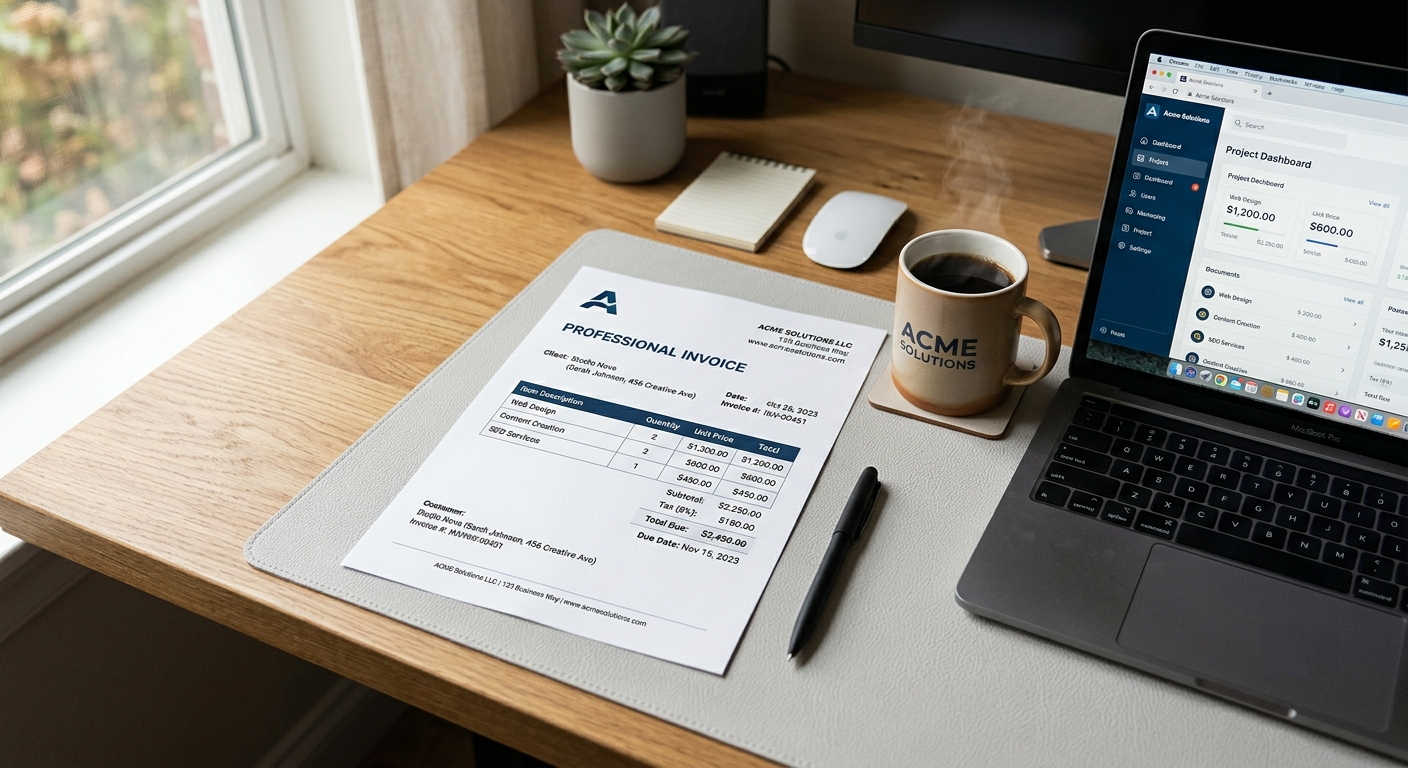
That's a lot easier to do consistently when your invoices are clean and dated in the first place. If you're tracking payments loosely, in a mix of bank apps and memory, it's hard to know at a glance what you've actually earned this quarter, which makes the whole estimate feel like guesswork instead of arithmetic.
The takeaway
Quarterly estimated taxes aren't a trap or a penalty for being self-employed. They're just the self-employed version of what happens automatically for employees: tax collected as you go, instead of in one bill at the end. The mechanics are genuinely simple once you've done it once: set aside a percentage of every payment, use last year's return as your safe harbor baseline, and pay by April 15, June 15, September 15, and January 15.
Miss a quarter and the sky won't fall, but it will cost you a bit in interest, so it's worth building the habit early rather than catching up under pressure.
And if part of your struggle is simply not having a clear, dated record of what you've actually invoiced and been paid this quarter, use our free invoice generator to create clean, numbered PDF invoices in a couple of minutes. It won't calculate your tax bill for you, but it gives you exactly the kind of paper trail that turns "how much did I even make this quarter" into a number you can look up in ten seconds.