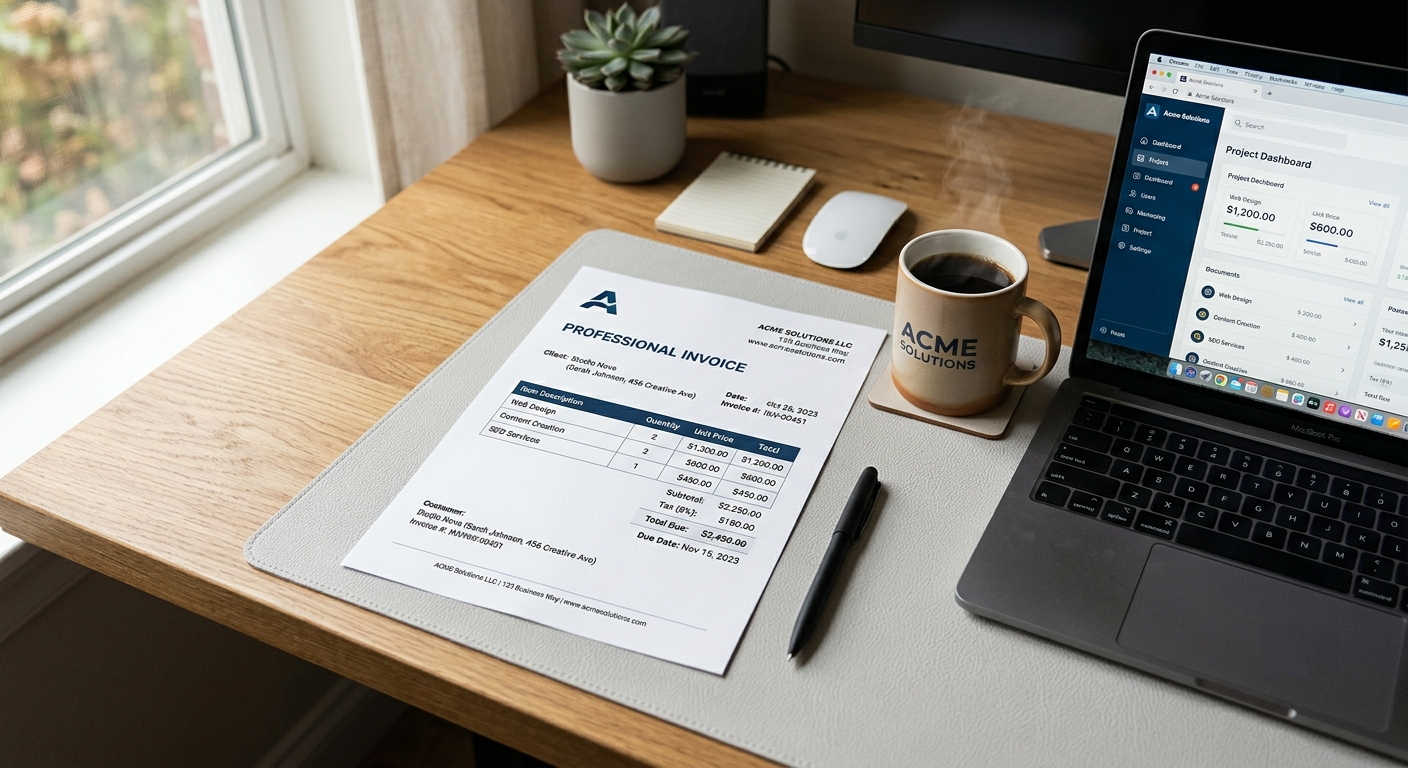
The first time a client emails back asking you to "reissue the invoice with your HST number on it," it stings a little. The work was fine. The invoice looked fine. But it was missing something the CRA cares about, and your client's accounts payable team caught it before you did.
That's how a lot of Canadian freelancers and small business owners find out that GST/HST invoices come with actual rules. They aren't complicated rules, but they are specific, and they change depending on how big the invoice is.
This guide covers all of it: whether you need to charge GST/HST in the first place, what has to appear on the invoice at each threshold, how to show your registration number, which rate to use, and what to do when your client is in the US.
The quick answer
If you're registered for GST/HST, the CRA expects certain details on your invoices so that your business clients can claim input tax credits (ITCs) on what they paid you. The required list grows with the invoice total:
- Under $100: your business name, the invoice date, and the total amount.
- $100 to $499.99: everything above, plus your GST/HST registration number, the tax charged (or a statement that the total includes tax, along with the rate), and enough of a description to identify what you sold.
- $500 and over: everything above, plus your client's name, the payment terms, and a description of each item.
These thresholds were raised from $30 and $150 back in 2021, so if you've seen older guides quoting the lower numbers, they're out of date.
Most freelance and contractor invoices land above $500, which means the full list should be your default. It's simpler to include everything every time than to remember which tier you're in.
First question: do you even need to charge GST/HST?
Not everyone does. Canada has what's called the small supplier rule. If your total taxable revenue is $30,000 or less over four consecutive calendar quarters, you don't have to register. And if you aren't registered, you don't charge GST/HST at all. In fact, you're not allowed to. Collecting sales tax without a registration number is a problem of its own.
Once you pass $30,000, how quickly you have to act depends on how you got there.
You crossed it in one quarter. Say you land a big contract and bill $34,000 between July and September. You stop being a small supplier right away, and you're expected to charge GST/HST on the very sale that pushed you over. You then have 29 days to register.
You crossed it gradually. If you went over $30,000 across four quarters combined, without any single quarter doing it alone, you stay a small supplier until the end of the month after that quarter ends. Tax kicks in from that point.
Here's the mistake that costs people real money: continuing to invoice without tax after you've crossed the line, and registering late. The CRA can ask you to remit the GST/HST you should have charged, out of your own pocket, even though you never collected it. Going back to clients six months later and asking for an extra 13% is not a conversation anyone enjoys.
You can also register voluntarily before hitting $30,000. Plenty of freelancers do, because it lets them claim ITCs on business expenses like a new laptop or software subscriptions. The trade-off is that once you're registered, you have to charge tax and file returns, even in slow years.
What your GST/HST number looks like
When you register, the CRA gives you a GST/HST account number. It's your nine-digit Business Number (BN), followed by the letters RT and four digits, usually 0001. It looks like this:
123456789 RT0001
That full 15-character version is what goes on your invoice. Just the nine-digit BN isn't enough, because the same BN is also used for payroll, import/export, and corporate income tax accounts. The RT part tells your client this is specifically your GST/HST account.
Clients can check your number on the CRA's online GST/HST Registry, and larger companies often do before they pay a new vendor. If the number doesn't validate, your payment can sit in limbo while someone in accounts payable emails you to ask about it. Double check it once, carefully, especially on a template you'll reuse for months.
The complete checklist for a CRA-friendly invoice
Here's the practical list, written for invoices of $500 or more, since that's where most freelance work lands:
- Your business name (your trade name, or your own name if you're a sole proprietor operating under it)
- The invoice date
- Your GST/HST registration number in the full RT format
- Your client's name or their trading name
- A description of each item or service, clear enough that someone reading it a year from now can tell what was supplied
- Payment terms, such as "Net 30" or "Due on receipt"
- The amount of GST/HST charged, shown separately, or a clear statement that the total includes GST/HST along with the rate
- The total amount payable
If a single invoice mixes taxable items with exempt or zero-rated ones, mark which lines the tax applies to. Your client needs to be able to see how the tax figure was calculated.
A few things aren't on the CRA's list but belong on every invoice anyway: an invoice number, your email or phone number, a due date, and how the client should pay you. The CRA doesn't technically require invoice numbers for GST/HST purposes, but try tracking payments across a dozen clients without them. We wrote a full guide on building an invoice numbering system if you want to set that up properly.
Do you have to show GST separately on an invoice?
This is one of the most searched questions on the topic, and the answer is: you have a choice, but one option is clearly better.
The rules allow you to either list the GST/HST amount as its own line, or show a tax-included total with a note like "Total includes HST at 13%." Both are legal for invoices of $100 or more.
In practice, business clients want it separated. Here's why. When they claim ITCs, they need the exact tax figure. If you give them a tax-included total, somebody on their end has to back out the tax manually. That's annoying, and it invites errors.
Here's what the cleaner version looks like for an Ontario client:
| Description | Amount |
|---|---|
| Website design, Phase 1 | $2,400.00 |
| Subtotal | $2,400.00 |
| HST (13%) | $312.00 |
| Total due | $2,712.00 |
Anyone looking at that invoice can see the tax, the rate, and the base amount in about two seconds.
Which rate do you charge?
This one catches a lot of people because the answer mostly depends on where your client is, not where you are. For services, the place of supply is generally based on your client's address. For physical goods, it's usually where they're delivered.
Here are the current rates as of September 2026:
| Province or territory | Tax charged | Rate |
|---|---|---|
| Ontario | HST | 13% |
| Nova Scotia | HST | 14% |
| New Brunswick, Newfoundland and Labrador, PEI | HST | 15% |
| Alberta, Yukon, NWT, Nunavut | GST | 5% |
| British Columbia, Manitoba, Saskatchewan | GST (PST handled separately) | 5% |
| Quebec | GST (QST handled separately) | 5% |
Nova Scotia's rate dropped from 15% to 14% on April 1, 2025. If you still have an old template set to 15% for Nova Scotia clients, now is a good time to fix it.
So an Alberta freelancer billing a Toronto client charges 13% HST. A Toronto freelancer billing a Calgary client charges 5% GST. It feels backwards at first, but once you've done it a couple of times it becomes automatic.
A quick note on PST and QST: provincial sales taxes in BC, Saskatchewan, and Manitoba, and the QST in Quebec, are separate systems with their own registration rules. Many professional services aren't subject to PST at all, but some are. If you do a lot of work for clients in those provinces, it's worth a quick check with the province or an accountant.
Do you charge GST/HST to US clients?
"Do I charge GST to US customers?" shows up constantly in Canadian search suggestions, and for good reason. A lot of Canadian freelancers work mainly for American companies.
In many cases, the answer is no. Services supplied to a non-resident business that isn't registered for GST/HST are often zero-rated. That means the supply is still taxable, but at 0%. You don't collect anything from the client, you still report the sale on your GST/HST return, and you can still claim ITCs on your own business expenses.
There are exceptions, though. Zero-rating generally doesn't apply when:
- The service is performed for an individual while they're physically in Canada
- The service relates to real property in Canada (for example, renovating a cottage in Muskoka owned by someone in Michigan)
- The service is on physical goods that are located in Canada at the time
Keep records that show your client is a non-resident, such as their business address and your signed contract. On the invoice itself, a line like "GST/HST: 0.00 (zero-rated, services supplied to a non-resident)" makes it clear you didn't simply forget.
The rules here have more edge cases than we can cover in one post, so if a large chunk of your income comes from outside Canada, a short session with an accountant is well worth the fee.
For US businesses reading this: if you hire a Canadian contractor and their invoice shows 0% GST/HST, or no Canadian tax at all, that's usually normal and nothing to worry about.
Common mistakes to avoid
Charging tax before you're registered. If you don't have a GST/HST number yet, you can't put tax on an invoice. Register first.
Showing only the nine-digit BN. Always include the RT0001 portion.
Using your own province's rate out of habit. A Manitoba freelancer billing a New Brunswick client charges 15% HST, not 5% GST.
Leaving descriptions vague. "Services rendered" technically describes something, but it won't help anyone during a review. "Brand identity package: logo, colour palette, and style guide" is much better.
How to set this up in our invoice generator
If you're using our free invoice generator, setting up a GST/HST-ready invoice takes about a minute:
- Open Settings and set your currency to CAD.
- Change the Tax Label from "Tax" to "HST" or "GST" so it prints correctly on the PDF.
- Enter the correct rate for your client's province in the tax rate field.
- Add your full GST/HST number (for example, 123456789 RT0001) under your business details.
- Add your payment terms in the notes, like "Net 30." Our guide to invoice payment terms explains which one to pick.
The subtotal, tax line, and total are calculated automatically and shown separately, which is exactly what your clients' bookkeepers want to see.
Quick FAQ
Does an invoice under $100 need my GST/HST number? No. Under $100, the CRA only requires your business name, the date, and the total. Many businesses include the number anyway, which doesn't hurt.
How long do I need to keep GST/HST invoices? Generally six years from the end of the tax year they relate to. We break this down in detail in how long to keep invoices in the US and Canada.
Can I fix an invoice that's missing my registration number? Yes. Issue a corrected invoice with the same details plus the missing information, and keep both copies in your records.
The takeaway
GST/HST invoicing sounds intimidating until you realize it's really just a checklist. Know whether you need to be registered. Put your full RT number on every invoice. Show the tax separately at the rate that matches your client's province. And if your client is outside Canada, check whether the sale is zero-rated before you add 13% to a US company's bill.
Get the template right once, and every invoice after that is basically fill in the blanks. Create a GST/HST-ready invoice for free with no signup, and download a clean PDF your clients' accountants will actually be happy to receive.