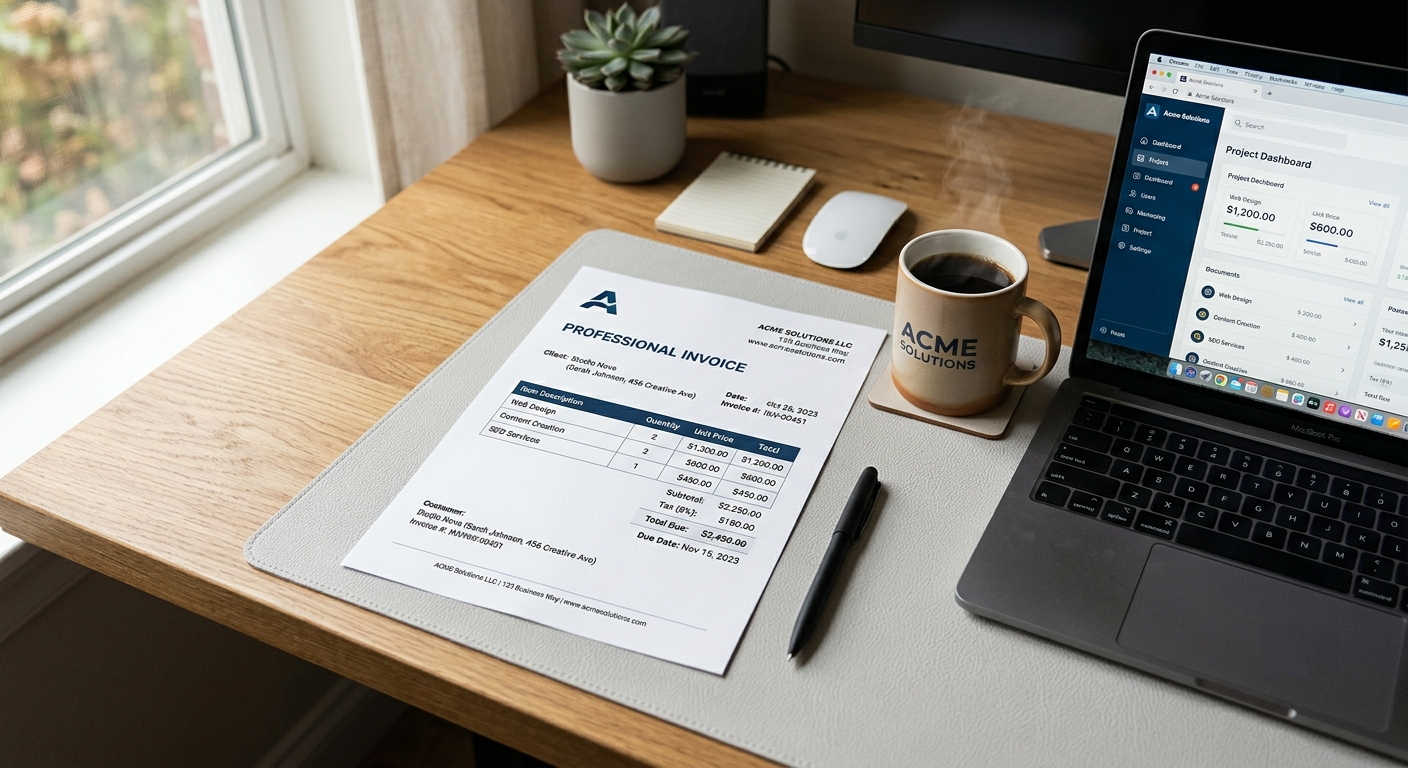
You finally did it. You told a new client you need 50% upfront before starting, and they said yes without blinking. Great.
Now you're staring at a blank invoice wondering how this actually works. Do you bill the whole project and write "50% now"? Do you send two separate invoices? What does the final invoice look like once the deposit is paid? And does the deposit count as income right away?
This guide answers all of that, with a real deposit invoice example and a matching final invoice you can copy.
The quick answer
To invoice for a deposit:
- Agree on the deposit amount in writing, usually in your quote or contract.
- Create a separate invoice just for the deposit, with its own invoice number.
- Describe it clearly, for example: "50% deposit for website redesign, per Quote Q-2026-014."
- Set the due date before your start date.
- When the project is done, send a final invoice that shows the full project cost, subtracts the deposit you already received, and lists the balance due.
That's the whole process. The rest of this post walks through each step and the details that trip people up.
What is a deposit invoice?
A deposit invoice is a real invoice that asks for part of the project price before the work begins. It's sometimes called a down payment invoice, an upfront payment invoice, or an advance invoice. They all mean roughly the same thing.
It's worth separating this from a couple of lookalikes:
Security deposit. Money held as protection and returned later if nothing goes wrong, like a damage deposit on equipment rentals. This isn't a payment toward the work. Most freelancers don't use these.
Retainer. Usually a recurring fee that reserves your time each month, or a pool of prepaid money you bill hours against. Related, but not quite the same as a one-time project deposit.
Deposit (the kind we're talking about). A partial payment toward a specific project. It gets credited against the final bill.
Deposit invoice vs. proforma invoice
This question comes up a lot, and the two are easy to confuse.
A proforma invoice is a preliminary document. It shows what a client will be billed, often so they can get internal approval, arrange financing, or clear customs. It isn't a formal demand for payment and usually isn't recorded as income or used for tax purposes. You can learn more on our proforma invoice page.
A deposit invoice is a real invoice. It asks for actual payment now, it has its own invoice number, and it goes into your books when it's paid.
Some businesses send a proforma first to show the full project price, then a deposit invoice to actually collect the upfront payment. That's fine, as long as you treat the deposit invoice as the official one.
How much deposit should you ask for?
There's no universal rule, but these ranges are common:
| Project type | Typical deposit |
|---|---|
| Small projects (under about $1,000) | 50% to 100% upfront |
| Mid-size freelance projects | 30% to 50% |
| Large or long projects | 25% to 30%, then milestone payments |
| Work requiring materials or bookings | Enough to cover those costs, at minimum |
50% upfront is the most popular choice among freelancers because it's easy to explain and it splits the risk evenly. The client knows you're committed, and you know they're serious.
One important exception: some US states cap deposits in certain industries, especially home improvement and construction. California, for example, generally limits home improvement deposits to 10% of the contract price or $1,000, whichever is less. If you're a contractor working on homes, check your state or provincial rules before setting your deposit.
Step by step: how to write a deposit invoice
Step 1: Get the deposit agreed in writing
Before you invoice anything, the deposit should appear in your quote, estimate, or contract. Something like:
"A 50% deposit ($2,000) is due before work begins. The remaining balance ($2,000) is due within 14 days of project completion."
This way, the deposit invoice doesn't come as a surprise. It's just the next step in something the client already signed off on. If you haven't sent a quote yet, our free quote template makes it quick.
Step 2: Create the deposit invoice
Treat it like any other invoice. It needs all the usual pieces: your business details, the client's details, an invoice number, the invoice date, and a due date. If you need a refresher on the basics, see our guide on how to invoice a client.
Step 3: Write a clear line item
The line item is where people get vague. Don't just write "Deposit." Include:
- The percentage or amount
- What project it's for
- A reference to the quote or contract
Good: "50% deposit for website redesign project, per Quote Q-2026-014 dated September 2, 2026"
Too vague: "Deposit"
Step 4: Set the due date before your start date
If you plan to start on September 29, make the deposit due by September 26. Then add a line to the notes: "Work will begin once the deposit is received." That one sentence does a lot of quiet work. It makes the dependency clear without sounding pushy.
Step 5: State your refund policy
Is the deposit refundable if the client cancels? Say so on the invoice, and make sure it matches your contract. For example:
"This deposit is non-refundable once work has begun, as it covers scheduling and initial project costs."
A clearly stated policy prevents most arguments before they start.
Example: a 50% deposit invoice
Here's what a complete deposit invoice looks like for a $4,000 website project.
Invoice #: 2026-051 Invoice date: September 17, 2026 Due date: September 26, 2026
| Description | Qty | Rate | Amount |
|---|---|---|---|
| 50% deposit for website redesign project, per Quote Q-2026-014 | 1 | $2,000.00 | $2,000.00 |
| Total due | $2,000.00 |
Notes: Work begins upon receipt of the deposit. The remaining balance of $2,000.00 will be invoiced upon project completion. This deposit is non-refundable once work has begun.
Short, specific, and impossible to misread.
Example: the final invoice after the deposit
This is where most people get stuck. There are two ways to handle it, and one is clearly better.
Option A (recommended): Show the full price, then subtract the deposit
Invoice #: 2026-063 Invoice date: October 24, 2026 Due date: November 7, 2026
| Description | Qty | Rate | Amount |
|---|---|---|---|
| Website redesign project (per Quote Q-2026-014) | 1 | $4,000.00 | $4,000.00 |
| Subtotal | $4,000.00 | ||
| Less: deposit received Sept 24 (Invoice 2026-051) | -$2,000.00 | ||
| Balance due | $2,000.00 |
This version tells the whole story in one place. The client can see the total project cost, confirm the deposit was credited, and know exactly what's left. Their bookkeeper will thank you.
Option B: Bill only the remaining balance
You could also send an invoice with a single line: "Remaining 50% balance for website redesign project, $2,000.00." It works, but it hides the full picture. If there were extra charges or changes along the way, it gets confusing fast. Stick with Option A when you can.
Does a deposit count as income right away?
For most freelancers and small businesses, yes.
In the US, if you use cash-basis accounting (which most sole proprietors do), income is generally counted when you receive it. So a deposit received in December counts toward that year's income, even if you finish the work in January. That matters for your quarterly estimated taxes, so set aside your usual tax percentage from deposits too.
In Canada, if you're registered for GST/HST, a deposit that's a partial payment toward the work is generally treated as a payment for the supply, which means GST/HST usually applies when the deposit is paid. In plain terms, charge the tax on the deposit invoice, not just the final one. A true security deposit that's held and returned is different; tax generally applies only if and when it's kept as payment. Our guide to GST/HST invoice requirements covers what the invoice itself needs to show.
Sales tax in the US varies a lot by state and depends on what you're selling. Many services aren't taxed at all. If you do charge sales tax, apply it consistently across the deposit and final invoices.
Tax rules have plenty of exceptions, so if deposits are a big part of your business, run your setup past an accountant once.
Common deposit invoicing mistakes
Not giving the deposit invoice its own number. Every invoice needs a unique number, including deposits. If you need help setting that up, see our post on invoice numbering systems.
Starting work before the deposit clears. The entire point of a deposit is protection. If you start early, you've given that protection away.
Forgetting to credit the deposit on the final invoice. It happens more than you'd think, and double-billing a client is an awkward email to receive.
Leaving the refund terms unclear. "Is my deposit refundable?" is much easier to answer when it's written on the invoice.
Calling it a "retainer" when it's really a deposit. Pick the right word and use it consistently in your contract and invoices.
How to do this in our invoice generator
Our free invoice generator handles both halves of the deposit process:
- For the deposit invoice, add a single line item describing the deposit, with a clear note about the start date and refund policy.
- For the final invoice, list the full project, then enter the deposit in the Amount Paid field. The tool automatically shows the amount paid and calculates the Balance Due, which gives you the Option A layout without any manual math.
If you want ready-made wording for deposit and refund terms, our invoice terms and conditions template has copy-and-paste examples.
Quick FAQ
Should a deposit be on a separate invoice? Yes. A separate deposit invoice keeps your records clean and gives both you and your client a clear paper trail.
Can I send a deposit invoice before the contract is signed? You can, but it's better to have the signed agreement first. The deposit invoice should confirm an agreement, not replace it.
What if the client wants to pay the full amount upfront? Great. Send a single invoice for the full amount and note that it's paid in advance. No final invoice needed, just a receipt when the work is delivered if they ask for one.
What's the best wording for a deposit on an invoice? Keep it specific: the percentage, the project name, and the quote or contract reference. For example: "50% deposit for kitchen cabinet installation, per Contract C-2026-008."
The takeaway
Asking for a deposit is one of the smartest habits you can build as a freelancer or small business owner. It filters out clients who aren't serious, covers your upfront costs, and makes getting ghosted a lot less painful.
The invoicing side is simple once you've done it once. Agree on the deposit in writing, send a separate numbered deposit invoice, wait for payment before starting, then send a final invoice that shows the full price minus the deposit.
Create your deposit invoice for free right now. No signup, no watermark, just a clean PDF ready to send.